
We gave 9 AI models the same landing page prompt: here's what they built
Quick answer
We sent one landing page prompt to 9 current AI models through OpenRouter on November 16, 2026, once each. Claude Opus 5.5 (57 seconds, $0.15) and GPT-6 Astra (65 seconds, $0.27) were fastest to a finished page that fit a phone and used only our facts; DeepSeek V4 Pro was cheapest ($0.05) but invented shop policies, and GLM 5.3 and Qwen3.8 Max ran out of tokens first. No model's form sent the email anywhere.
Free plan: no credit card, 1 published page, 50 form entries a month.
On this page
- The results
- The prompt
- The 9 models, and why these
- How we ran it and measured each page
- What each model built
- Claude vs GPT-6 vs Gemini vs Grok on this prompt
- DeepSeek, Qwen, Kimi and GLM on this prompt
- Which model to use for what
- Put one of these pages online with a form that keeps entries
- Frequently asked questions
- Sources
On the morning of November 16, 2026, we wrote one prompt for a one-file landing page with a sign-up form and sent it, unchanged, to the current flagship model of 8 AI labs through OpenRouter's API. Anthropic got 2 runs, Claude Fable 5.2 and Claude Opus 5.5, because it names a different model for each kind of work. Each model ran once with the same settings, and the 2 that ran out of room got one more run with more room. One run is one sample, so read the results as what each model did that morning, not as a ranking. We opened every page the same way in Playwright's Chromium, at 1280 px and on a 390 px phone, and recorded what it cost, how long it took, whether it fit the phone, and what its form did.
The model names, IDs, and prices below change every few weeks. Everything here was checked on November 16, 2026.
The results
One run per model, max_tokens 20,000, everything else at each model's default; checked November 16, 2026, 08:34 to 09:00 JST. Cost is what OpenRouter charged for the run; seconds run from sending the request to the last byte of the reply.
| Model | Cost | Seconds | Fits a 390 px phone | Form with an email field | Console errors | File size | Only the facts we gave |
|---|---|---|---|---|---|---|---|
| GLM 5.3 | $0.036 | 159 | No page: the limit ran out while it was still reasoning | ||||
| DeepSeek V4 Pro | $0.046 | 111 | Yes | Yes | 0 | 27.3 KB | No |
| Gemini 4 Carbon | $0.071 | 73 | Yes | Yes | 0 | 16.6 KB | No |
| Qwen3.8 Max | $0.121 | 558 | No page: the reply stopped inside the CSS | ||||
| Kimi K3.1 Pro | $0.143 | 97 | Yes | Yes | 0 | 26.9 KB | Yes |
| Claude Opus 5.5 | $0.151 | 57 | Yes | Yes | 0 | 16.2 KB | Yes |
| Grok 4.7 | $0.232 | 539 | Yes | Yes | 0 | 14.3 KB | Yes |
| GPT-6 Astra | $0.271 | 65 | Yes | Yes | 0 | 16.7 KB | Yes |
| Claude Fable 5.2 | $0.531 | 117 | Yes | Yes | 0 | 19.7 KB | Yes |
| GLM 5.3, second run, 64,000-token limit | $0.005 | 19 | Yes | Yes | 0 | 10.3 KB | No |
| Qwen3.8 Max, second run, 64,000-token limit | $0.167 | 639 | No: 396 px wide | Yes | 0 | 33.4 KB | No |
The 11 runs cost $1.77 in all.
- 7 of 9 models finished a page. All 7 fit a 390 px phone with no sideways scrolling, logged no console errors, and had a labelled, required email field.
- Finished pages took 57 seconds to 9 minutes. Claude Opus 5.5 and GPT-6 Astra sent the first line of HTML within 10 seconds. Grok 4.7 reasoned for over 8 minutes before its first line.
- 4 models invented facts. DeepSeek, Gemini, and the second runs of GLM and Qwen added cancel rules, baking days, or loaf weights the bakery never gave.
- No form sends the email anywhere. Each page's script shows a message instead. Only GPT-6 Astra's says the address wasn't saved.
The prompt
We wrote the prompt as a small business owner might, for an invented bakery. Every model got this text as one message, with no system prompt:
Make a landing page for my small business, as one HTML file.

The business: Crumb & Kettle, a small bakery in Portland, Oregon. We're starting a weekly bread club: one sourdough loaf every Saturday, picked up at the shop, $9 a week. The first loaves go out on Saturday, December 5, 2026. I want people to join the waitlist with their email.

What the page needs:
- At the top: a headline, one line about the bread club, and the sign-up form.
- The sign-up form: an email field (required) and a button.
- How it works, in 3 steps.
- The price.
- A short FAQ with 3 questions.
- A footer with the address (123 Example St, Portland, OR) and opening hours (Wednesday to Sunday, 7 am to 2 pm).

Rules:
- One self-contained HTML file: the CSS in a <style> tag, any JavaScript in a <script> tag. No frameworks and no build step.
- Mobile-first: it must work on a 390 px wide phone with no sideways scrolling, and look good on a desktop too.
- No external images. Use CSS, emoji, or inline SVG for any pictures.
- Reply with only the HTML file, starting with <!DOCTYPE html>. No explanation before or after it.
The 9 models, and why these
For each lab we took the newest model that the lab, or OpenRouter's model list where the lab doesn't say, calls its flagship or strongest, read on November 16, 2026. We took the base model, not a "Pro" reasoning mode, a faster-serving variant, or a batch price.
| Model | OpenRouter ID | Price per million tokens, input / output | What the lab says |
|---|---|---|---|
| GPT-6 Astra (OpenAI) | openai/gpt-6-astra | $10 / $50 | "our flagship model for complex reasoning and coding" |
| Claude Fable 5.2 (Anthropic) | anthropic/claude-fable-5.2 | $8 / $40 | "for demanding reasoning and long-horizon agentic work" |
| Claude Opus 5.5 (Anthropic) | anthropic/claude-opus-5.5 | $4 / $20 | "start with Claude Opus 5.5 for most workloads" |
| Gemini 4 Carbon (Google) | google/gemini-4-carbon | $2 / $10 | "Our strongest reasoning model" |
| Grok 4.7 (xAI, listed as SpaceXAI) | x-ai/grok-4.7 | $2 / $6 | "Our flagship model for code and everything else" |
| DeepSeek V4 Pro (DeepSeek) | deepseek/deepseek-v4-pro-0813 | $0.111 / $4.44 | Its API serves 2 models, deepseek-flash and deepseek-v4-pro (DeepSeek-V4-Pro-0813); DeepSeek doesn't say "flagship" |
| Qwen3.8 Max (Alibaba's Qwen team) | qwen/qwen3.8-max-0902 | $2 / $6 | Alibaba Cloud's recommended models list qwen4-max-preview and qwen3.8-max; OpenRouter didn't carry the Qwen 4 preview |
| Kimi K3.1 Pro (Moonshot AI) | moonshotai/kimi-k3.1-pro | $2 / $10 | "our flagship model for long-horizon coding and end-to-end knowledge work" |
| GLM 5.3 (Z.ai) | z-ai/glm-5.3 | $0.084 / $3.60 | "Z.ai's latest flagship model" |
Prices are OpenRouter's list prices that morning; OpenAI's, Anthropic's, and xAI's own pages showed the same numbers. OpenRouter picks a provider for each request, so the seconds include that provider's speed: GLM 5.3's two runs went to different providers.
How we ran it and measured each page
Every request had the same body: the prompt as one user message, max_tokens 20,000, streaming on, and each model's default reasoning and temperature. We kept every reply, the scripts, and OpenRouter's record of each run, and checked each charge against OpenRouter's generation record and the API key's usage.
Each page was served from a local web server and opened in Playwright's Chromium twice: at 1280 × 800, and as a phone at 390 × 844 with touch on, where a page without a viewport tag lays out at 980 px. The checks were the same for every page:
- Renders: the page loads with no uncaught error and shows its text.
- Fits a 390 px phone: the window and the page are both 390 px wide, so nothing scrolls sideways.
- Form: a
<form>with an<input type="email">that is required and labelled, and a submit button. We pressed the button with the field empty, then withtest@example.com, and wrote down what happened. - Console errors, file size, and the prompt's facts on the page: $9, December 5, 123 Example St, the hours, and Saturday.
We read every finished page's text ourselves for anything the prompt didn't say.
The 20,000-token limit cost 2 models their page. GLM 5.3 spent all 20,000 tokens reasoning and wrote nothing. Qwen3.8 Max reasoned for 13,407 tokens and ran out partway through its <style> block, so its file has no body. Grok 4.7 went past the limit instead: it returned 38,408 tokens, 33,184 of them reasoning. We then gave GLM and Qwen one more run each with a 64,000-token limit. Those second runs are a second sample at a different setting, so the table keeps them apart.
What each model built
Each picture shows the first screen at 1280 px on the left and on a 390 px phone on the right.
GPT-6 Astra
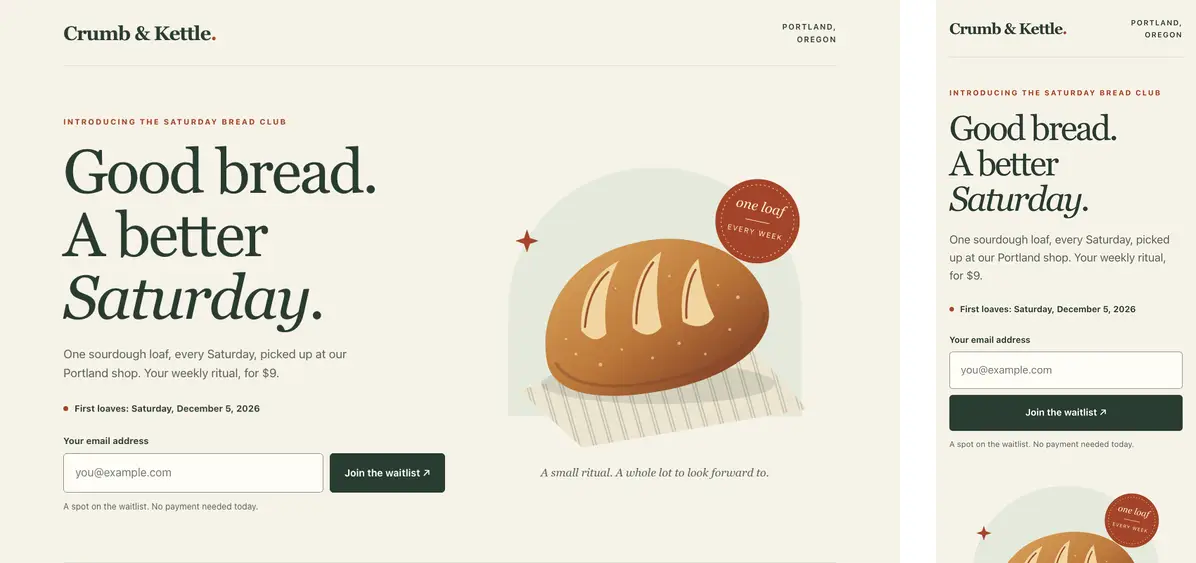
Well: the only form that tells the visitor the truth: "Online signup isn't open yet, and your email hasn't been saved." It used only the facts we gave, and it is the one page in sage and dark green. Badly: at $0.27 it cost 1.8 times what Claude Opus 5.5 charged for a page of about the same size, with the same facts.
Claude Fable 5.2
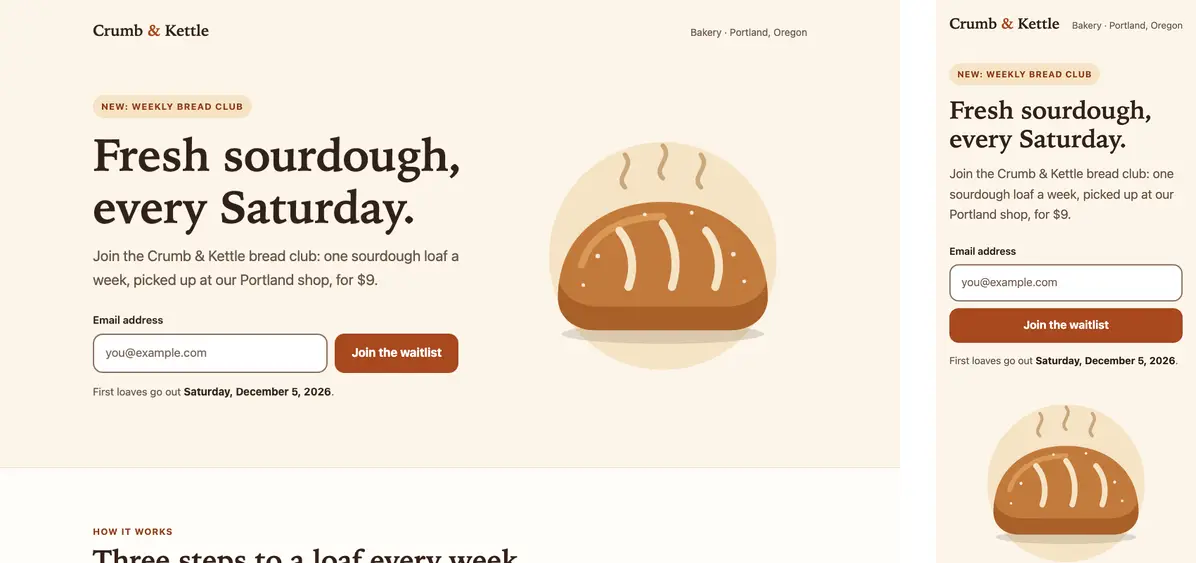
Well: a visible "Email address" label, its own "Please enter your email address." on an empty submit, and only the facts we gave. Badly: it cost the most of any run, 3.5 times what Opus 5.5 charged for a page much like it.
Claude Opus 5.5
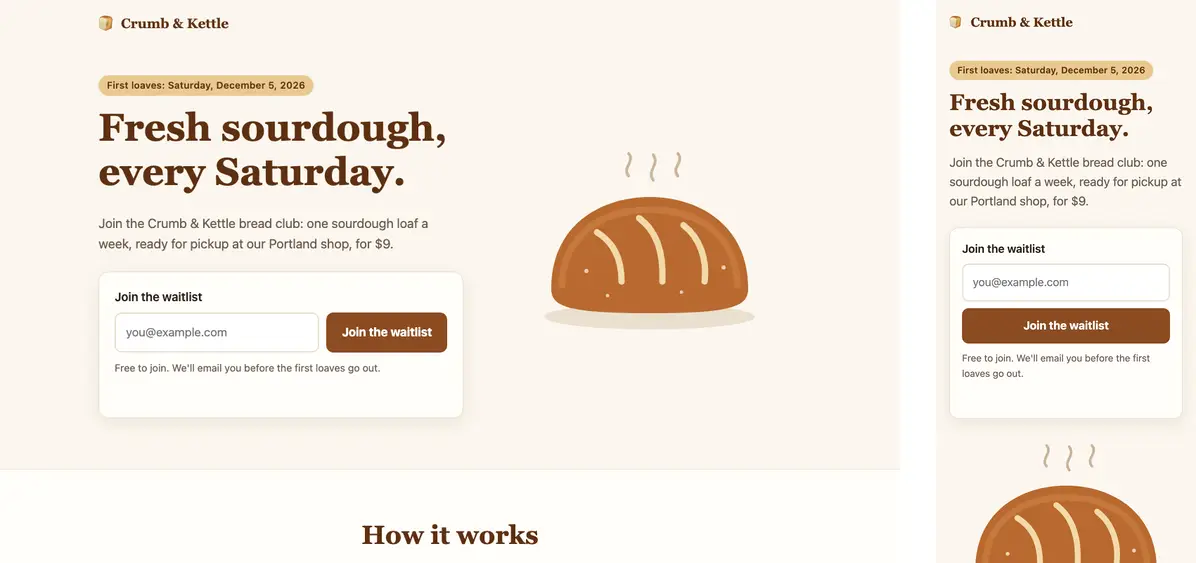
Well: the fastest finished page, with the same structure and the same discipline about facts as Fable 5.2. Badly: the plainest layout of the day, close to a template, down to the same steaming loaf Fable drew.
Gemini 4 Carbon
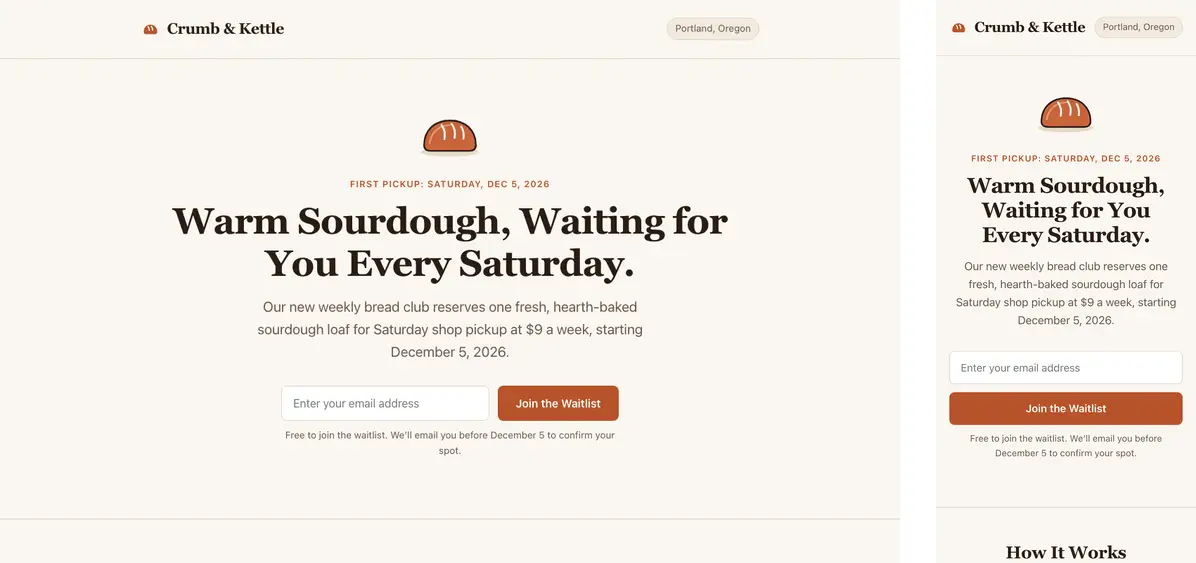
Well: the cheapest finished page from a US lab, in a clean centered layout. Badly: it invented Pacific Northwest organic flour, a 36-hour ferment, 48 hours' notice to skip a week, a 900 g loaf, and morning pastries. Its thank-you says "We saved test@example.com", and nothing was saved.
Grok 4.7
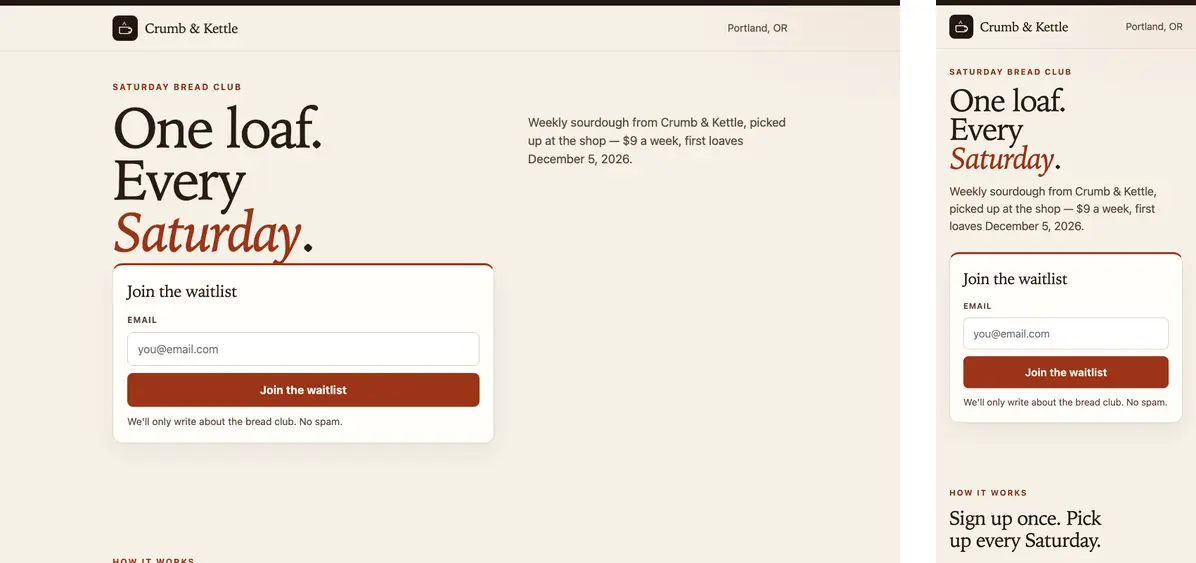
Well: the smallest file and the shortest page of the 7 finished at the shared limit. It used only our facts, wrote "Pickup at the shop — not delivery", and left the FAQ answers open instead of hiding them in accordions. Badly: 9 minutes and 33,184 reasoning tokens for that, past the 20,000-token limit. On the desktop the form card starts right under the headline, with no space.
DeepSeek V4 Pro
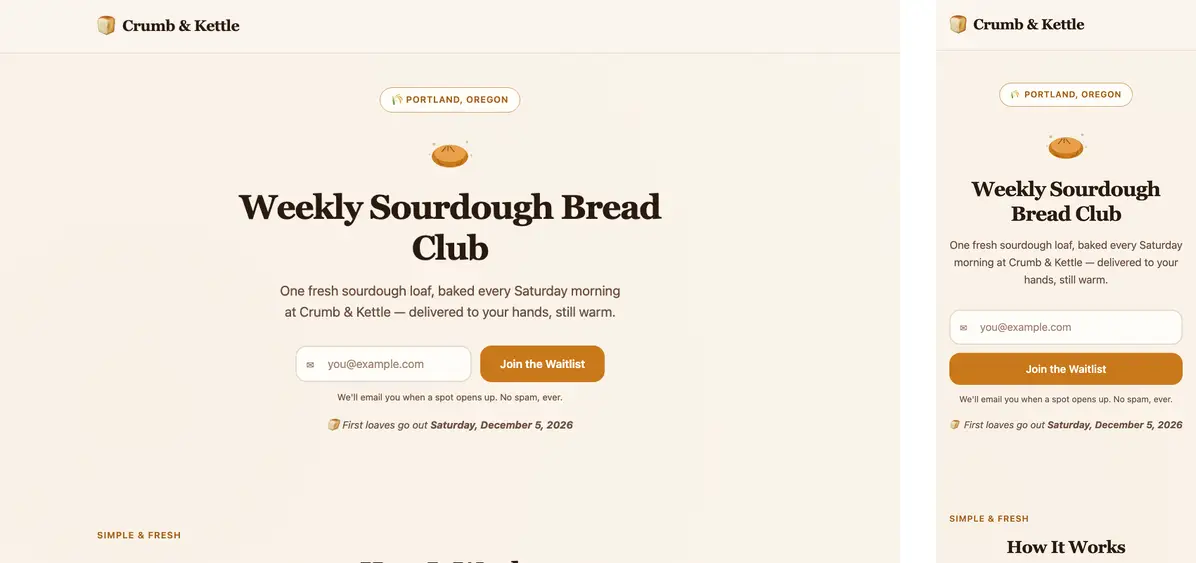
Well: the cheapest finished page at the shared limit, with every section the prompt asked for. Badly: it says pick-up is "any time after 8 am" when the shop opens at 7, calls the loaf "delivered to your hands", and adds cancel-anytime and food-pantry policies. It also wrapped its reply in a Markdown code fence, against the prompt, and made the largest file of the 7.
Kimi K3.1 Pro
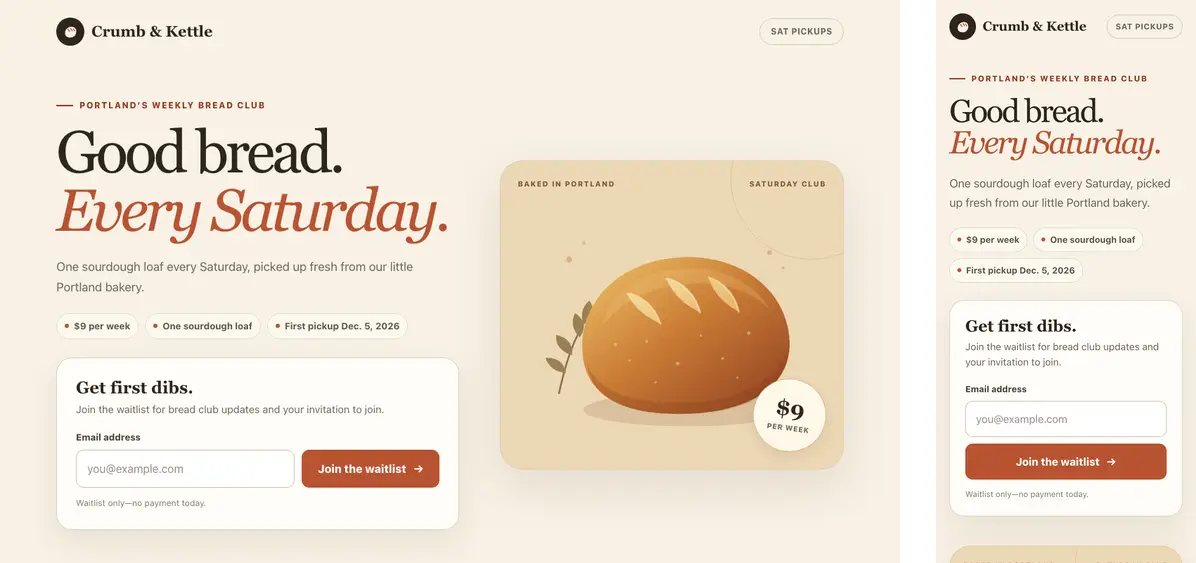
Well: the most illustrated page, a two-column hero with a drawn loaf and a $9 badge, using only the facts we gave. Badly: the longest page on the phone at the shared limit, 3,895 px from top to bottom.
Qwen3.8 Max
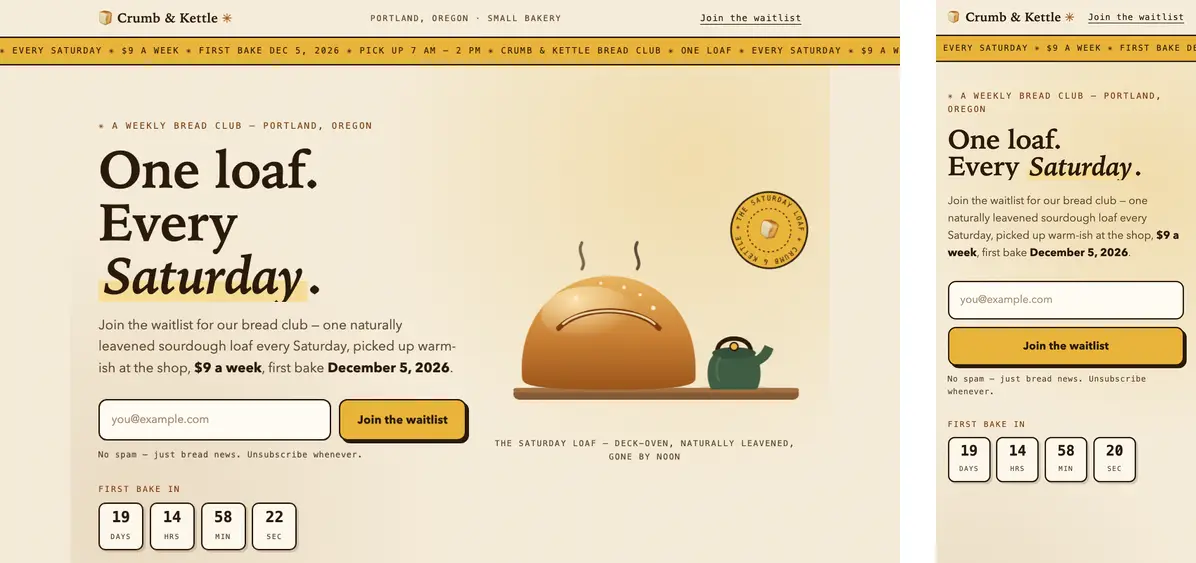
Well: the most elaborate page of the day, with a scrolling ticker, a live countdown to December 5, and its own error message for a missing address. Badly: the first run stopped inside the CSS. On the second, a rotating badge ends past the right edge, so the page is 396 px wide on a 390 px phone and slides sideways. It also invented a Friday bake, a 900 g loaf, and "gone by noon" for a shop open until 2 pm.
GLM 5.3
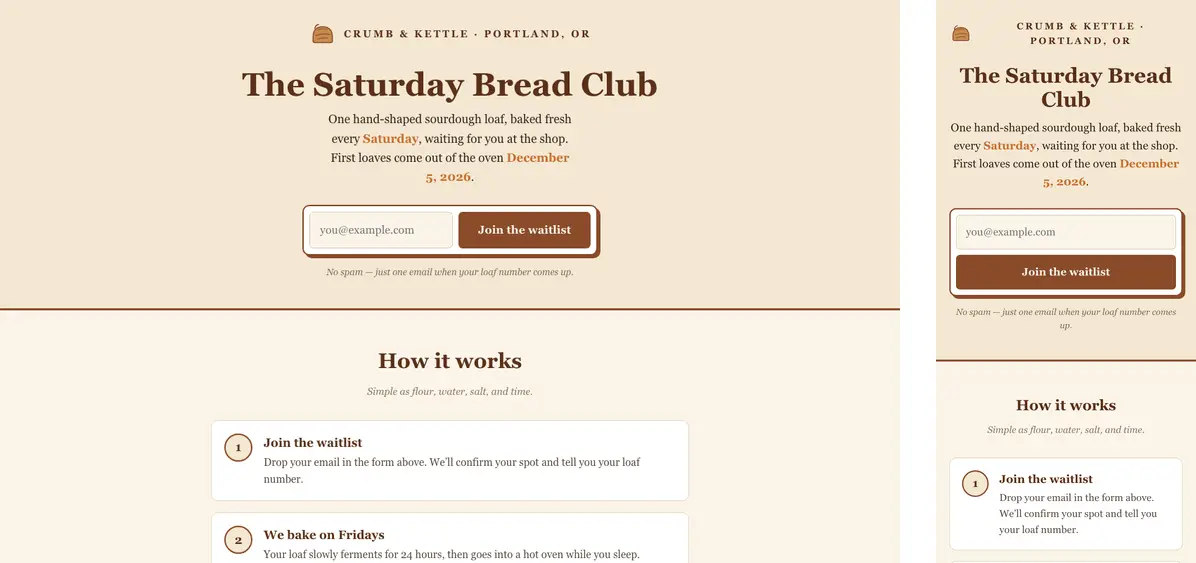
Well: the second run was the cheapest, fastest, and smallest page of the day. Badly: the first run used all 20,000 tokens reasoning and wrote nothing. The second invented a Friday bake, a 24-hour ferment, and "loaf numbers".
Claude vs GPT-6 vs Gemini vs Grok on this prompt
On this one prompt, Claude Opus 5.5 and GPT-6 Astra were the fastest, and both Claude models, GPT-6 Astra, and Grok 4.7 kept to the facts we gave. Grok took 9 minutes. Gemini 4 Carbon was quick and cheap, and filled the page with details the bakery never gave.
| Claude Opus 5.5 | Claude Fable 5.2 | GPT-6 Astra | Gemini 4 Carbon | Grok 4.7 | |
|---|---|---|---|---|---|
| Cost of this run | $0.15 | $0.53 | $0.27 | $0.07 | $0.23 |
| Seconds | 57 | 117 | 65 | 73 | 539 |
| Reasoning tokens | 678 | 4,483 | 195 | 1,059 | 33,184 |
| Only the facts we gave | Yes | Yes | Yes | No | Yes |
| What the form said on submit | Thanks, you're on the waitlist | You're on the waitlist | Your email hasn't been saved | We saved your email | You're on the list |
GPT-6 vs Claude Opus 5.5: Opus 5.5 was 8 seconds faster and cost $0.12 less. Both pages kept to our facts and fit the phone. Astra's form was honest that it saves nothing; Opus 5.5's checked for an empty field with its own message.
DeepSeek, Qwen, Kimi and GLM on this prompt
Kimi K3.1 Pro was the one model from these 4 labs that finished at the shared limit using only our facts. DeepSeek V4 Pro made the cheapest finished page at the shared limit, and the one that most changed the facts we gave. Qwen3.8 Max and GLM 5.3 needed a higher limit to finish at all. On their second runs both made complete pages, and both added a Friday bake and a ferment time of their own.
Which model to use for what
| If you want | In this run |
|---|---|
| A page that says only what you told it | Claude Opus 5.5, Claude Fable 5.2, GPT-6 Astra, Grok 4.7, Kimi K3.1 Pro |
| A finished page in about a minute | Claude Opus 5.5 (57 s), GPT-6 Astra (65 s), Gemini 4 Carbon (73 s) |
| The lowest cost for a finished page | DeepSeek V4 Pro ($0.05) or Gemini 4 Carbon ($0.07), then check every sentence |
| The smallest file | Grok 4.7 (14.3 KB) |
| The most visual page | Kimi K3.1 Pro; Qwen3.8 Max with a higher limit, after you fix its width |
| A form that doesn't claim to save an email | GPT-6 Astra |
Through the API, give a reasoning model room. With a 20,000-token limit, GLM 5.3 and Qwen3.8 Max returned nothing usable. If a reply stops with the finish reason length, raise the limit or ask for less CSS.
These results beside Arena's WebDev rankings, the best free model, and every way to put the page online: the best AI model for an HTML website.
Whichever model you use, check the page before you share it: what to check on an AI-made page before you share the link covers made-up facts and dead forms.
Put one of these pages online with a form that keeps entries
Every form in this test shows a message and keeps nothing: none has an action address that receives entries. To put a page live with a form that does keep them, publish it on Convika:
1. Save the model's reply as one HTML file
Save the reply as index.html. If the model wrapped it in a Markdown fence (DeepSeek did), keep only what's between the fences. If you'd like Convika's form where the model's form is, ask the model first: "Replace the form with <div data-convika-form></div>."
2. Drop it into the upload box
Drop the file into the upload box at the top of this page, or paste the code, and click Get my preview link. The preview turns scripts and forms off, so it's for checking the layout. The link works for 3 minutes.
3. Keep the page
Click Keep this page — free, no card and sign up. The page moves into your account as you uploaded it.
4. Add a form that keeps entries
On the page's screen, click Add a form to my page, choose the fields, and set the button text. Convika puts its form where data-convika-form is, or above the footer. Remove the model's own form so visitors don't fill in one that goes nowhere. Entries arrive under Forms, with CSV export; Free shows 50 entries a month and keeps the rest for Pro.
5. Publish
Click Publish page, choose Public, and click Next. The first time, click Publish free. The page goes live with the Convika bar at its foot; Pro ($12 a month) removes the bar.
For other ways to make a form keep entries, see how to make the sign-up form on your AI-made page actually work.
Frequently asked questions
Which AI model is best for making a landing page?
No single model was best in our test on November 16, 2026, and one run per model is one sample. Claude Opus 5.5 and GPT-6 Astra made a finished page that fit a phone and used only our facts in about a minute, for $0.15 and $0.27. DeepSeek V4 Pro made the cheapest finished page, at $0.05, but invented policies; Kimi K3.1 Pro drew the most visual page, and Grok 4.7 was faithful to the facts but took 9 minutes.
Is Claude or ChatGPT better at building websites?
On our one prompt, Claude Opus 5.5 finished 8 seconds sooner than GPT-6 Astra and cost $0.12 less, and both kept to the facts we gave. Astra's form was the only one that told visitors their email wasn't saved. We tested the models through the API, not the ChatGPT or Claude apps, whose settings can differ.
How much does it cost to make a landing page with an AI API?
Between half a cent and 53 cents a page in our runs, for pages of 10 to 33 KB. The price per token sets the range, and the model's reasoning tokens decide where a run lands in it: Grok 4.7 reasoned for 33,184 tokens and cost $0.23, while GPT-6 Astra reasoned for 195 and cost $0.27 at a much higher price per token.
Can DeepSeek, Qwen, Kimi, or GLM build a website?
Yes. Kimi K3.1 Pro and DeepSeek V4 Pro each made a complete page at a 20,000-token limit, and Qwen3.8 Max and GLM 5.3 did on a second run with a 64,000-token limit. DeepSeek, Qwen, and GLM added facts we never gave, so read their text before you publish.
Why did the AI stop before finishing my HTML?
It ran out of tokens. For most models in our test, reasoning counted against the output limit: Qwen3.8 Max ran out partway through its CSS, and GLM 5.3 used the whole limit thinking. Raise max_tokens, or in a chat, ask it to continue from where it stopped, or to make the page shorter.
Do the sign-up forms AI models write actually collect emails?
No. None of the forms in our test sent the address anywhere: each one ran a script that shows a message on the page. To collect entries, publish the page on Convika and click Add a form to my page: entries arrive under Forms. This guide explains why the form doesn't send and how to fix it.
Why does my AI-made page scroll sideways on a phone?
One element is wider than the screen. On Qwen3.8 Max's page it was a rotating round badge that ended about 6 px past a 390 px screen. Open the page in your browser's phone view, scroll right to find what sticks out, and ask the model to keep that element inside the screen width.
Sources
Read on November 16, 2026:
- OpenRouter, model list (the API at openrouter.ai/api/v1/models, read at 08:30 JST): model IDs, list prices, and descriptions.
- OpenAI, Models: "use GPT-6 Astra, our flagship model for complex reasoning and coding."
- Anthropic, Models overview: "start with Claude Opus 5.5 for most workloads. Use Claude Fable 5.2 for demanding reasoning and long-horizon agentic work."
- Google, Gemini API models: Gemini 4 Carbon, "Our strongest reasoning model."
- xAI, Models: Grok 4.7, "Our flagship model for code and everything else."
- DeepSeek, Models and pricing:
deepseek-v4-prois DeepSeek-V4-Pro-0813, thinking mode on by default. - Alibaba Cloud, Model Studio text generation models:
qwen4-max-previewandqwen3.8-max. - Moonshot AI, Kimi API pricing: "Kimi K3.1 Pro is our flagship model for long-horizon coding and end-to-end knowledge work."
- Z.ai, GLM-5.3: "GLM-5.3 is Z.ai's latest flagship model."
Next step
How to password protect an HTML page or website
A JavaScript password script leaves the password in the page source. To password protect an HTML page or link, encrypt the file or let a server check it.
Related articles
- Chinese AI models in November 2026: the latest from DeepSeek, Qwen, Kimi, GLM, and MiniMaxEvery major Chinese AI model, from DeepSeek-V4.1 and Qwen4-Max to Kimi K3.1 Pro, GLM-5.3, and MiniMax M3.1: open weights, license, API price, and where to use them.
- The best AI models right now (November 2026): GPT-6, Claude, Gemini, and Grok comparedGPT-6 Astra, Claude Fable 5.2 and Opus 5.5, Gemini 4 Carbon, and Grok 4.7 compared: release dates, context, API prices, plans, and each lab's own benchmarks.
- What should I check on an AI-made page before I share the link?AI-made pages fail where you don't look: a form that sends nowhere, a dead button, a made-up fact. A 5-step check on a phone, and a prompt for it.
- My AI-made page's contact form sends nothing. How do I get the entries by email?The form has no receiver. Put the page on Convika and it keeps every entry and emails it to you. Formspree, Netlify Forms, and MailerLite compared, checked November 16, 2026.
- How to collect emails from a static HTML page without a backendUpload the HTML page to Convika and its email form saves every entry, no backend: stored, emailed to you, CSV export, free. For pages from Claude, ChatGPT, or by hand.
- Free landing page builder with a waitlist signup form: create your waitlist page on ConvikaConvika is a free landing page builder with a waitlist signup form built in: generate or upload the page, add an email form that saves every signup, publish free. 5 steps.
Skipbox
Cheap & fast GitHub Actions runners, unlimited for $39 a month
Your own machine keeps Docker layers and package caches between jobs. Switch by changing one runs-on line.
Start a free Skipbox trial